
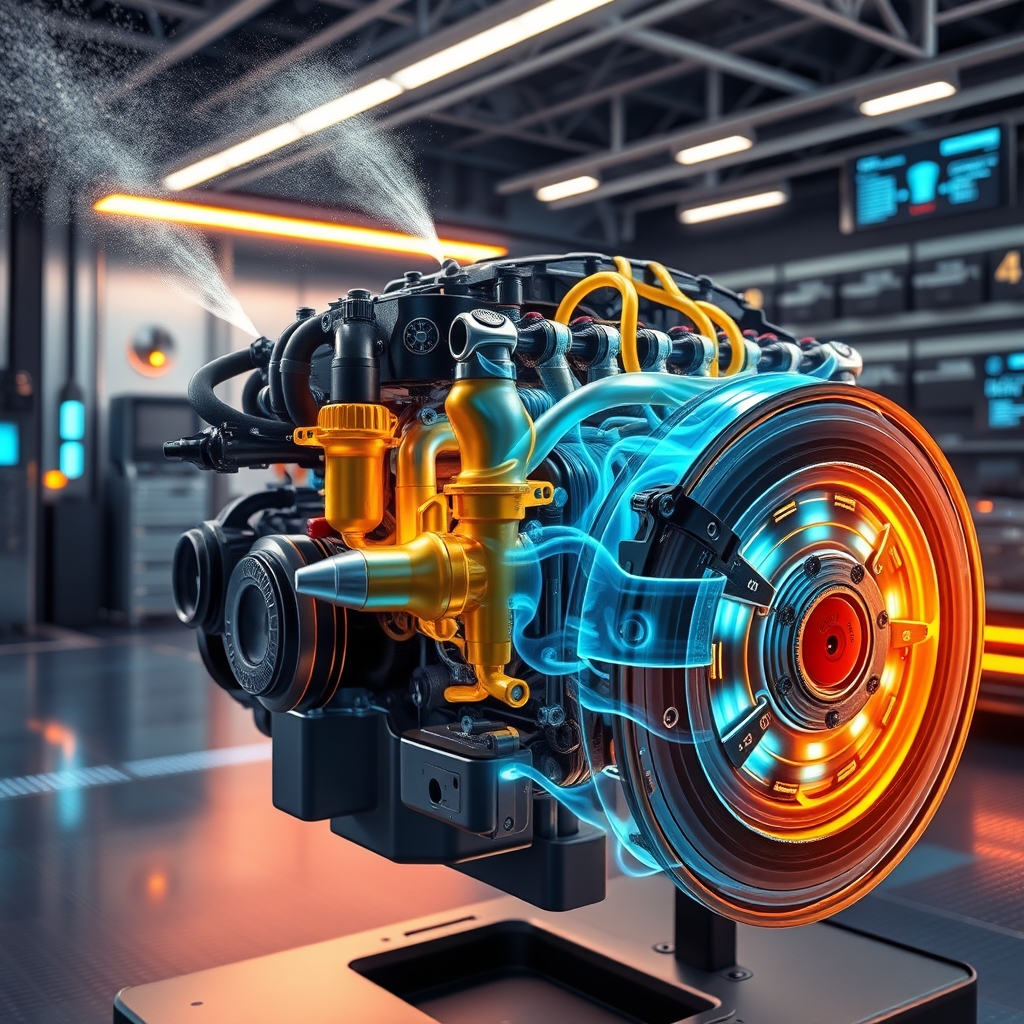
Few aspects of automotive engineering are as critical yet as overlooked as fluid dynamics. While engines, aerodynamics, and electronics often steal the spotlight, the way fluids move through a vehicle—from fuel and oil to coolant and brake fluid—plays a foundational role in performance, efficiency, and safety. This unseen ballet of liquids and gases ensures that every component operates at peak efficiency, whether you’re accelerating on the highway or navigating city traffic. Without precise fluid management, even the most advanced powertrains would falter, and modern vehicles would struggle to meet the demands of today’s drivers.
The Invisible Backbone of Engine Performance
At the heart of every vehicle lies the engine, a complex machine where fluid dynamics govern everything from combustion to cooling. Fuel injection systems, for instance, rely on precise fluid atomization to ensure optimal air-fuel mixtures. Modern direct injection technologies, which spray fuel directly into the combustion chamber, demand meticulous control over fluid pressure and droplet size. Too large, and the fuel won’t burn efficiently; too small, and it can lead to incomplete combustion, increasing emissions and reducing power. Engineers use computational fluid dynamics (CFD) to simulate and refine these processes, ensuring that every drop of fuel contributes to performance rather than waste.
Similarly, engine oil isn’t just a lubricant—it’s a dynamic fluid that must adapt to extreme temperatures and pressures. High-performance synthetic oils, for example, are engineered to maintain viscosity across a wide range of conditions, reducing friction and wear. Advanced oil pumps and variable displacement systems further optimize flow, ensuring that critical components receive lubrication precisely when needed. Without these innovations, engines would overheat, seize, or degrade prematurely, turning what should be a reliable machine into a ticking time bomb.
Cooling Systems: The Unsung Heroes of Reliability
While engines generate power, they also produce heat—lots of it. Without effective cooling, this heat would quickly lead to catastrophic failure. Automotive cooling systems, which circulate coolant through the engine block and radiator, are a masterclass in fluid dynamics. The challenge lies in balancing flow rate, pressure, and temperature to prevent overheating while avoiding overcooling, which can reduce efficiency. Modern systems use electric water pumps, thermostatic valves, and even predictive algorithms to maintain optimal temperatures, adapting in real-time to driving conditions.
But cooling isn’t just about the engine. Transmission fluids, differential oils, and even battery coolants in electric vehicles (EVs) rely on fluid dynamics to function. In EVs, for example, battery thermal management systems use liquid cooling to prevent overheating during fast charging or high-performance driving. Without these systems, batteries would degrade faster, reducing range and lifespan. The precision of fluid flow in these applications can mean the difference between a vehicle that lasts 100,000 miles and one that fails at half that distance.
Braking Systems: Where Fluid Dynamics Meet Safety
When it comes to safety, few systems are as dependent on fluid dynamics as brakes. Hydraulic brake systems rely on incompressible brake fluid to transfer force from the pedal to the calipers, clamping the rotors and slowing the vehicle. The fluid must remain free of air bubbles, which can compress and reduce braking efficiency, and it must resist boiling under high temperatures generated by friction. High-performance brake fluids, such as those used in racing or heavy-duty applications, are formulated to withstand extreme heat without losing their hydraulic properties.
Advanced braking systems, like anti-lock braking (ABS) and electronic brakeforce distribution (EBD), further leverage fluid dynamics to enhance safety. ABS, for example, uses sensors and valves to modulate brake pressure rapidly, preventing wheel lockup and maintaining steering control. These systems rely on precise fluid flow to function, making them a testament to the critical role of fluid dynamics in modern automotive safety.
The Future: Smart Fluids and Adaptive Systems
As vehicles become more advanced, so too do the fluids that keep them running. Emerging technologies like magnetorheological (MR) fluids, which change viscosity in response to magnetic fields, are being explored for adaptive suspension systems. These fluids could allow vehicles to adjust damping in real-time, improving both comfort and handling. Similarly, nanofluids—engineered with nanoparticles to enhance thermal conductivity—are being tested for more efficient cooling in high-performance and electric vehicles.
In the realm of EVs, fluid dynamics will play an even greater role. Battery cooling, thermal management for power electronics, and even the flow of electrolytes within the battery cells themselves are all areas where fluid dynamics will shape the next generation of vehicles. As automakers push for faster charging, longer ranges, and greater efficiency, the ability to control and optimize fluid flow will be a key differentiator.
The next time you start your car, take a moment to appreciate the unseen forces at work beneath the surface. From the fuel burning in the cylinders to the coolant circulating through the engine, fluid dynamics are the lifeline that keeps your vehicle moving. As automotive technology evolves, these systems will only become more sophisticated, ensuring that the cars of tomorrow are not only faster and more efficient but also safer and more reliable than ever before. The road ahead is paved with innovation, and fluid dynamics will be driving it forward, one drop at a time.
About the Author