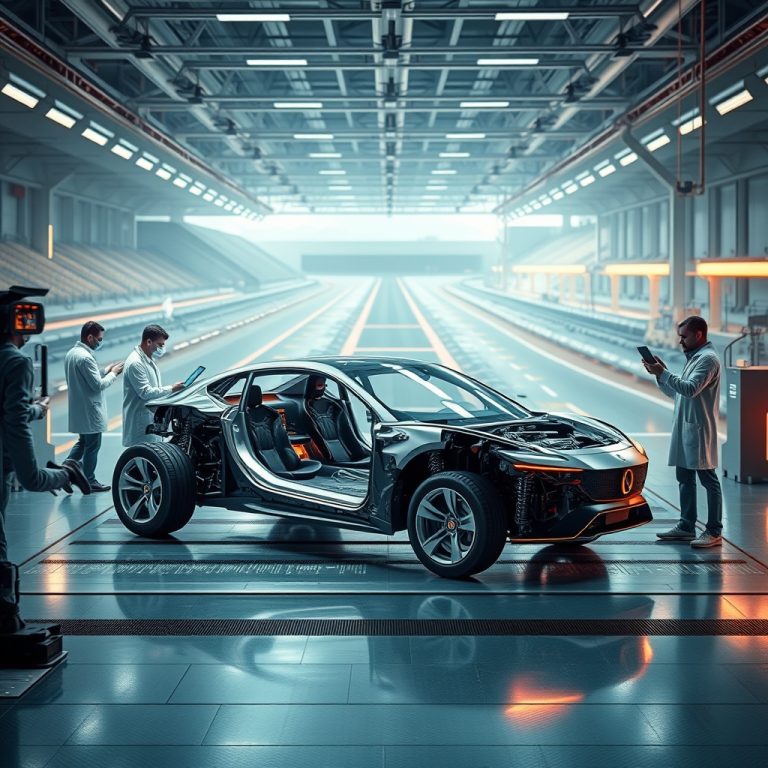

The automotive world has long been obsessed with speed, power, and performance, but one of the most transformative advancements in recent years has been nearly invisible to the naked eye. Active aerodynamics—a technology that dynamically adjusts a vehicle’s shape and airflow in real-time—is quietly revolutionizing how cars handle, consume fuel, and even look. Unlike traditional fixed aerodynamic elements, such as spoilers or diffusers, active systems respond to driving conditions, optimizing performance without compromise. This innovation is not just for hypercars or race tracks; it’s rapidly becoming a staple in mainstream vehicles, reshaping the future of automotive engineering.
The Science Behind the Silence
At its core, active aerodynamics relies on a network of sensors, actuators, and computer algorithms that continuously monitor speed, steering input, road conditions, and even ambient temperature. These systems make split-second adjustments to components like grille shutters, rear wings, underbody panels, and even side mirrors to reduce drag, increase downforce, or improve cooling. For example, at high speeds, a car might deploy a rear spoiler to enhance stability, while at lower speeds, it retracts to minimize air resistance and improve fuel efficiency. The result is a vehicle that adapts like a living organism, balancing performance and efficiency in ways static designs never could.
One of the most compelling applications of active aerodynamics is in electric vehicles (EVs), where range anxiety remains a significant concern. By reducing drag at cruising speeds, EVs can eke out additional miles on a single charge, making them more practical for everyday use. Tesla’s Model S Plaid, for instance, uses an active rear spoiler that deploys at high speeds to improve stability, while simultaneously adjusting the front grille to optimize airflow to the battery and motors. This seamless integration of form and function is a testament to how far the technology has come.
From Race Tracks to Daily Commutes
The origins of active aerodynamics can be traced back to motorsports, where every fraction of a second counts. Formula 1 cars, for example, have long used adjustable wings and flaps to fine-tune downforce during races. However, the real breakthrough came when these technologies trickled down to production cars. Porsche’s 911 GT3 RS is a prime example, featuring an active rear wing that can adjust its angle of attack to provide either maximum downforce for cornering or minimal drag for straight-line speed. What was once the domain of elite race cars is now available to enthusiasts and everyday drivers alike.
But active aerodynamics isn’t just about speed. It’s also about safety. By dynamically adjusting a vehicle’s aerodynamic profile, these systems can improve stability in crosswinds or during emergency maneuvers. For instance, some high-end sedans now feature active grille shutters that close at high speeds to reduce drag but open when the engine needs cooling. This not only enhances performance but also reduces the risk of overheating, which can lead to mechanical failures. The technology is so effective that it’s even being used in trucks and SUVs to improve fuel economy without sacrificing towing capacity or payload.
The Challenges and Future of Active Aerodynamics
Despite its promise, active aerodynamics is not without its challenges. The systems are complex, requiring precise calibration to avoid unintended consequences, such as increased noise or reduced reliability. Additionally, the added weight of actuators and sensors can offset some of the efficiency gains, particularly in smaller vehicles. Cost is another hurdle, as the technology is still relatively expensive to implement, limiting its adoption to higher-end models. However, as with most automotive innovations, economies of scale are likely to drive down prices over time, making active aerodynamics a standard feature in the coming decades.
Looking ahead, the future of active aerodynamics is boundless. Advances in artificial intelligence and machine learning could enable even more sophisticated systems that predict driving conditions before they occur. Imagine a car that adjusts its aerodynamic profile based on upcoming turns, traffic, or even weather forecasts. We’re also likely to see greater integration with other vehicle systems, such as adaptive suspension or torque vectoring, creating a holistic approach to performance and efficiency. Some automakers are even experimenting with morphing body panels that can change shape on demand, further blurring the line between form and function.
The Environmental Imperative
Beyond performance and safety, active aerodynamics plays a crucial role in the automotive industry’s push toward sustainability. By improving fuel efficiency and reducing emissions, these systems help automakers meet increasingly stringent environmental regulations. For internal combustion engines, this means lower CO2 emissions, while for EVs, it translates to extended range and reduced battery strain. In an era where every gram of CO2 counts, active aerodynamics offers a tangible way to make vehicles greener without sacrificing the thrill of driving.
As we stand on the precipice of a new era in automotive design, active aerodynamics represents more than just a technological marvel—it’s a paradigm shift in how we think about cars. No longer are vehicles static machines with fixed capabilities; they are dynamic, intelligent systems that adapt to their environment and the needs of their drivers. Whether you’re a performance enthusiast, an eco-conscious commuter, or simply someone who appreciates cutting-edge engineering, the rise of active aerodynamics is a development worth watching. The road ahead is not just about where we’re going, but how we get there—and with every subtle adjustment to a spoiler or grille, the journey becomes smoother, faster, and more efficient than ever before.
About the Author