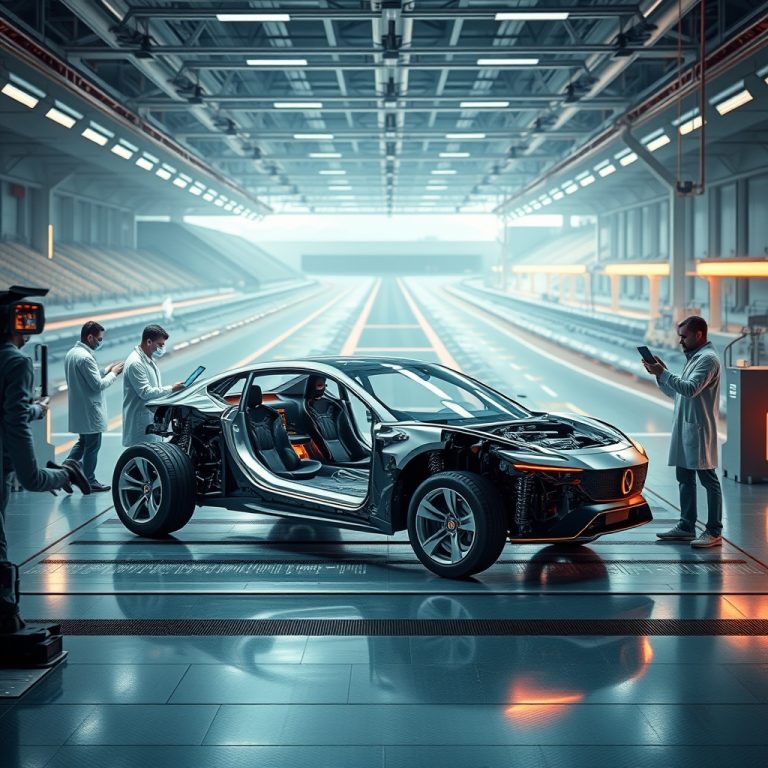

Imagine gliding down the highway at 70 mph, your car slicing through the air with the effortless grace of a bird in flight. What if we told you that the secret to this seamless experience isn’t just raw horsepower, but something far more elegant? The automotive industry is undergoing a quiet revolution, one where the shape of your vehicle is just as critical as the engine under the hood. Aerodynamics isn’t just about speed—it’s about efficiency, stability, and even the future of sustainable driving. And the best part? You’re already benefiting from it every time you hit the road.
The Science Behind Automotive Aerodynamics
Aerodynamics is the study of how air flows around objects, and in the world of vehicle design, it’s a game-changer. At its core, automotive aerodynamics focuses on reducing drag—the resistance your car faces as it moves through the air. The lower the drag, the less energy your engine needs to maintain speed, which translates to better fuel efficiency and reduced emissions. But it’s not just about going fast; it’s about doing so intelligently.
Every curve, angle, and contour of a modern car is meticulously engineered to manipulate airflow. From the sleek slope of the hood to the subtle spoilers at the rear, these design elements work together to minimize turbulence. Think of it like a swimmer’s streamlined cap and suit—they don’t make the swimmer stronger, but they allow them to move through the water with less resistance. The same principle applies to your car.
Why Drag Coefficient Matters
The drag coefficient (Cd) is a numerical value that quantifies how aerodynamic a vehicle is. The lower the Cd, the more efficiently the car cuts through the air. For example, a typical SUV might have a Cd of around 0.35, while a hyper-efficient electric vehicle like the Tesla Model 3 boasts a Cd of just 0.23. That might not sound like a huge difference, but over thousands of miles, it adds up to significant fuel savings and reduced wear on the engine.
Manufacturers achieve these low drag coefficients through a combination of wind tunnel testing, computational fluid dynamics (CFD), and real-world testing. It’s a blend of art and science, where designers and engineers collaborate to create shapes that are both visually striking and functionally superior. The result? Cars that don’t just look fast—they are fast, even at cruising speeds.
Beyond Speed: The Hidden Benefits of Aerodynamic Design
While speed is the most obvious benefit of aerodynamic design, it’s far from the only one. Modern automotive engineering leverages aerodynamics to enhance stability, reduce noise, and even improve safety. For instance, the way air flows over and under a car can affect how it handles at high speeds. A well-designed aerodynamic profile helps keep the car planted on the road, reducing lift and improving traction.
Noise reduction is another often-overlooked advantage. Turbulent airflow can create wind noise, which is a common complaint among drivers. By smoothing out the airflow, manufacturers can create a quieter cabin, making long drives more comfortable and less fatiguing. This is particularly important in electric vehicles, where the absence of engine noise makes wind noise more noticeable.
The Role of Active Aerodynamics
Not all aerodynamic features are static. Some of the most advanced automotive technologies today involve active aerodynamics—components that adjust in real-time to optimize performance. For example, some high-performance cars feature active spoilers that deploy at high speeds to increase downforce, improving grip and stability. Others have adjustable air vents that open or close to manage airflow to the engine or brakes, depending on driving conditions.
Electric vehicles (EVs) are taking active aerodynamics to the next level. Since EVs rely entirely on battery power, every bit of efficiency counts. Some models, like the Porsche Taycan, use active aerodynamic elements to reduce drag at cruising speeds, extending range without sacrificing performance. It’s a delicate balance, but one that’s becoming increasingly important as the industry shifts toward electrification.
The Future of Automotive Aerodynamics
The next frontier of aerodynamic innovation is already taking shape, and it’s more exciting than ever. With the rise of autonomous vehicles, designers are rethinking the very concept of car shapes. Without the need for a traditional driver’s seat or steering wheel, future cars could be designed purely for optimal airflow, leading to even lower drag coefficients and unprecedented efficiency.
Sustainability is also driving change. As the automotive industry moves toward greener manufacturing processes, aerodynamics will play a key role in reducing emissions. Lighter materials, combined with ultra-efficient designs, could make future cars not just faster and more efficient, but also more environmentally friendly. Imagine a world where your car’s design actively contributes to a cleaner planet—that’s the promise of next-generation aerodynamics.
Even today, aerodynamics is shaping the cars we drive in ways most people never notice. The next time you’re on the road, take a moment to appreciate the invisible forces at work. The sleek lines of your car aren’t just for show—they’re a testament to the ingenuity of modern engineering. And as technology advances, those lines will only get smarter, making every drive faster, smoother, and more efficient than the last.
About the Author