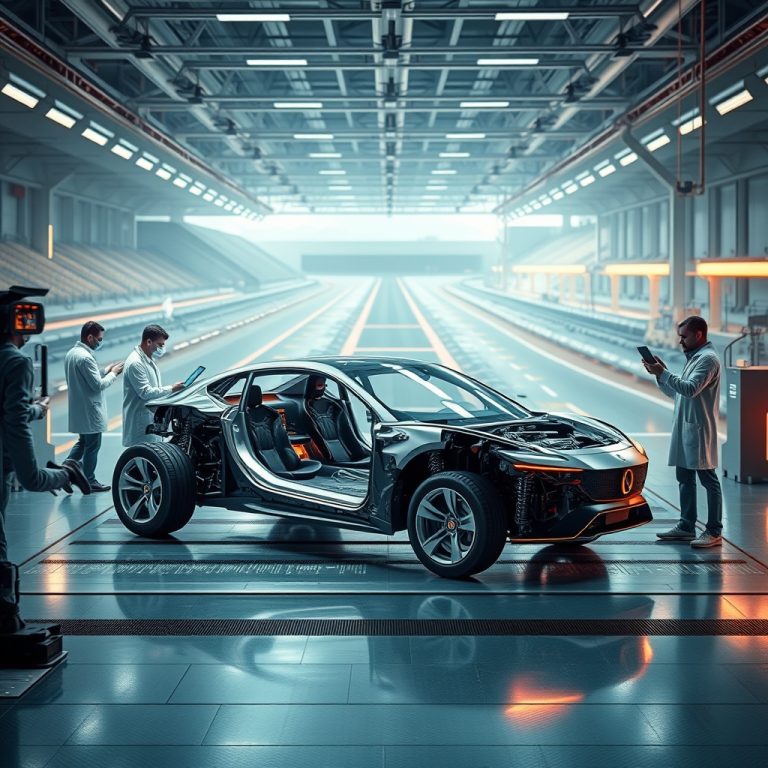

The quest for speed has always been at the heart of automotive innovation. From the earliest days of racing to the cutting-edge hypercars of today, engineers have relentlessly pursued ways to push the limits of what’s possible on four wheels. Yet, one of the most critical factors in achieving blistering speeds isn’t just raw horsepower—it’s an invisible force that keeps a car planted to the ground, allowing it to corner faster, brake later, and accelerate harder than ever before. This force is downforce, and it’s quietly revolutionizing the way we think about automotive performance.
The Science Behind the Stick
Downforce is the aerodynamic force that pushes a vehicle downward, increasing tire grip and stability at high speeds. Unlike lift, which can make an airplane take off, downforce does the opposite—it ensures that a car remains firmly in contact with the road. This is achieved through a combination of carefully designed aerodynamic elements, including spoilers, diffusers, and wings, which manipulate airflow to generate downward pressure. The physics behind it is deceptively simple: as air flows over and under the car, differences in pressure create a net force that pushes the vehicle toward the ground. The faster the car moves, the more downforce it generates, creating a self-reinforcing cycle of stability and control.
From Racing to the Road
While downforce has long been a staple in motorsports, its principles are now making their way into production vehicles. Formula 1 cars, for example, generate so much downforce that they could theoretically drive upside down on a ceiling at high speeds—a testament to the power of aerodynamics. But it’s not just race cars that benefit. Modern supercars and even some high-performance road cars now incorporate active aerodynamics, where components like rear wings and front splitters adjust dynamically to optimize downforce based on speed and driving conditions. This technology allows drivers to enjoy the best of both worlds: low drag on straightaways for maximum speed and high downforce in corners for unparalleled grip.
The Role of Computational Fluid Dynamics
The evolution of downforce wouldn’t be possible without advances in computational fluid dynamics (CFD). This technology allows engineers to simulate airflow around a vehicle with incredible precision, identifying areas where downforce can be maximized and drag minimized. By running thousands of virtual tests before a single physical prototype is built, manufacturers can fine-tune aerodynamic performance in ways that were once unimaginable. CFD has democratized aerodynamics, making it accessible to smaller teams and even independent tuners who can now experiment with designs that were once the exclusive domain of well-funded racing programs.
Beyond Speed: The Safety Implications
Downforce isn’t just about going faster—it’s also about staying safer. At high speeds, even the slightest loss of traction can have catastrophic consequences. By increasing downforce, engineers can reduce the risk of understeer or oversteer, giving drivers more confidence and control. This is particularly important in electric vehicles, where instant torque delivery can make traction management a challenge. Active aerodynamic systems can adjust downforce in real-time, compensating for sudden changes in speed or road conditions. In this way, downforce is becoming an essential tool for enhancing both performance and safety, proving that the pursuit of speed doesn’t have to come at the expense of security.
The Future of Downforce: Adaptive and Sustainable
As automotive technology continues to evolve, so too does the approach to downforce. One of the most exciting developments is the rise of adaptive aerodynamics, where sensors and artificial intelligence work together to optimize downforce on the fly. These systems can detect everything from road surface conditions to driver inputs, adjusting aerodynamic elements in milliseconds to provide the perfect balance of grip and efficiency. Additionally, sustainability is becoming a key consideration. Lightweight materials and innovative designs are reducing the environmental impact of aerodynamic components, ensuring that downforce doesn’t come at the cost of fuel efficiency or emissions. The future of downforce lies in systems that are not only smarter but also greener, aligning with the broader shift toward sustainable mobility.
The next time you see a sleek supercar hugging the road or a race car taking a corner at impossible speeds, remember that what you’re witnessing is the result of an invisible battle between air and metal. Downforce may not be as flashy as a roaring engine or as visible as a set of custom wheels, but it’s the unsung hero of modern automotive performance. As technology advances, this invisible force will continue to redefine what’s possible, pushing the boundaries of speed, stability, and safety in ways we’ve only begun to imagine. The road ahead is faster, safer, and more exhilarating than ever—and downforce is leading the charge.
About the Author